
Most people assume that after a crash, the hospital or clinic has written down everything that matters. In reality, medical records after a car accident only reflect what was noticed, discussed, assessed and documented at each visit.
Some symptoms may appear later or simply not come up during an appointment focused on more immediate injuries. Difficulty concentrating, disrupted sleep, headaches, low mood or unease about driving can therefore be missing from early notes.
A clearer medical record starts with accurate communication about what has changed, when it began, and how it is affecting everyday life.
| TL;DR |
| Medical records after a car accident do not automatically capture every symptom or change in recovery. Emergency notes document what was known early, while follow-up visits may record later problems involving concentration, sleep, mood, headaches, or daily activities. Accurate communication matters: describe symptoms honestly, explain when they began and how they affect daily life, and use a symptom diary as a memory aid rather than a substitute for clinical care. |
Why Your File Is Thinner Than You Think[1]
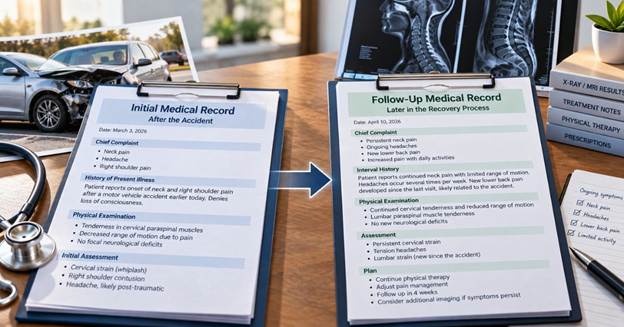
A medical record is not a complete recording of everything your body experienced after a crash. It reflects what was noticed, discussed, assessed and documented at particular points in time.
The same limitation appears at a much larger scale in the CDC’s brain injury data. The CDC reports approximately 214,110 TBI-related hospitalisations in the United States in 2020, but it also stresses that these estimates do not include TBIs treated only in an emergency department, primary care or urgent care, or those that go untreated. In other words, hospital admission data captures only part of the wider picture.
That caveat concerns national surveillance rather than individual medical records, but it highlights an important distinction: not every health problem enters the same healthcare setting or is documented at the same stage of recovery. Emergency care is designed to identify urgent threats, assess injuries that need immediate attention and decide what care is needed next. That is the right priority.
But symptoms do not always appear at the same time. Difficulty concentrating, changes in sleep, headaches, irritability or other problems may emerge later, or they may not be mentioned during an early appointment focused on more immediate concerns.
That does not mean the first medical note is wrong or inadequate. It means it is a snapshot. Follow-up records can add important information about symptoms and changes that were not present, recognised or discussed during the first hours after the crash.
The Emergency Department Note
The emergency department note is often the earliest detailed medical record after a crash. It can establish when you were seen, what you reported at the time, what clinicians observed, and which tests or treatment were considered necessary.
What It Captures Well
An emergency note may record the mechanism of the crash, arrival time, vital signs, visible injuries, areas of pain, neurological findings, and whether loss of consciousness or memory problems were reported. It will also usually document any imaging or laboratory tests performed and the clinician’s initial assessment.
That makes the record useful as an early snapshot. It shows what was known and clinically relevant during the first hours after the collision, rather than what became apparent later.
What It May Not Capture
Some symptoms may not have developed yet, while others may simply not come up during an appointment focused on immediate injuries. Problems with concentration, memory, sleep, light sensitivity or mood can sometimes emerge hours or days later.
A normal CT scan is also genuinely reassuring when clinicians are looking for certain acute problems, including bleeding in or around the brain. But CT imaging is not generally used to diagnose a mild traumatic brain injury or concussion itself. The CDC notes that concussion assessment relies on symptoms and clinical evaluation, while imaging may be used when there is concern about more serious injury.
This does not make the emergency record incomplete or unreliable. It means the note reflects what could be assessed at that particular point in recovery, which is why later records may contain information that was not present on day one.
The follow-up visit can become the more informative record
The first medical note captures what was happening soon after the crash. A follow-up appointment can add something different: a record of how symptoms developed after the first hours or days had passed and normal routines began again.
This matters because some problems may not appear immediately. Concentration difficulties, disturbed sleep, headaches, fatigue or changes in mood can emerge over the following hours or days. If those symptoms develop, persist or interfere with daily life, discussing them accurately with a healthcare professional helps the clinician decide what care or further assessment is appropriate.
Continuity also gives the medical record a sense of change over time. A clinician who sees someone more than once may be able to compare symptoms, function and recovery between visits rather than relying on a single snapshot.
A longer gap between the crash and follow-up care does not automatically mean that later symptoms are unrelated. It can, however, leave less contemporaneous clinical information about what happened during that period. That may matter later when someone needs to understand how recovery unfolded over time, whether that is another healthcare professional, an employer discussing adjustments, or someone reviewing medical evidence in an injury claim[2] [3] .
The reason to seek follow-up care should always be your health, not the creation of paperwork. The record is a by-product of the conversation. If something has changed since the first visit, describe what changed, when you first noticed it and how it is affecting everyday activities.
Records for Symptoms That May Not Appear on Imaging[4]
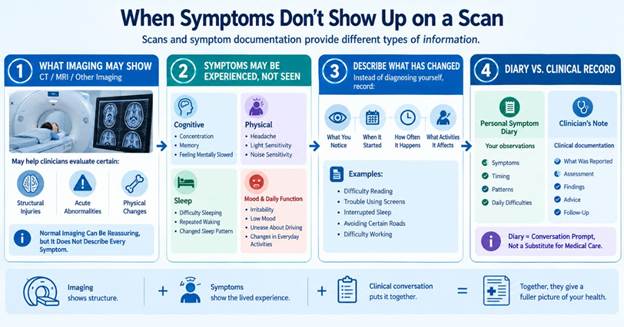
Some of the most disruptive changes after a crash are described through symptoms rather than shown directly on a scan. That can include changes in concentration, sleep, mood or confidence behind the wheel.
A normal scan can still be reassuring. It may help clinicians rule out certain acute structural injuries. But symptoms such as cognitive difficulty, sleep disturbance or emotional changes are often documented through conversation, clinical assessment and follow-up rather than through an image alone.
Concussion and Cognitive Symptoms
Concussion symptoms can include headaches, difficulty concentrating, memory problems, sensitivity to light or noise and feeling mentally slowed down. Some appear immediately, while others may develop hours or days later.
These symptoms should be described accurately rather than interpreted as proof of a particular diagnosis. Tell the clinician what you have noticed, when it began and how it is affecting ordinary tasks such as reading, working, following conversations or using screens.
The CDC provides detailed guidance on concussion symptoms and when medical assessment is appropriate. The important point for the medical record is simple: symptoms that are never mentioned may never appear in the clinical notes.
Sleep, Mood and Getting Back in the Car
A crash can also be followed by disrupted sleep and changes in mental wellbeing, irritability, low mood or unease about driving. For some people, feeling anxious about driving after an accident becomes noticeable only when they return to familiar roads or traffic situations. These experiences may feel unrelated to an appointment about neck pain or headaches, which can make them easy to leave out of the conversation.
If they are affecting everyday life, they are worth mentioning to a healthcare professional. Describe the experience rather than trying to diagnose it yourself. For example, saying that you wake repeatedly during the night or have stopped driving on certain roads gives the clinician more useful information than applying a label to what you think is happening.
Support or treatment may be available for these concerns. Bringing them up allows the clinician to consider whether further support, monitoring or referral is appropriate.
Why a Clinician’s Note Records Something Your Diary Does Not
A symptom diary can be useful for remembering details between appointments. It can help you keep track of when symptoms appeared, what activities became difficult and whether things changed over time. If writing helps you reflect on patterns in how you feel, mindfulness journalling can also provide a broader way to organise thoughts and observations.
But a personal diary and a clinical record serve different purposes. Your diary records your own observations. A clinician’s note records what was reported, what was assessed and any clinical findings, advice or follow-up that resulted from the appointment.
Use a diary as a prompt for the conversation, not as a substitute for care. Bringing a short, accurate list to an appointment can make it easier to discuss symptoms you might otherwise forget, particularly when several things have changed at once.
How to Describe Symptoms So They End Up in the Notes[5]
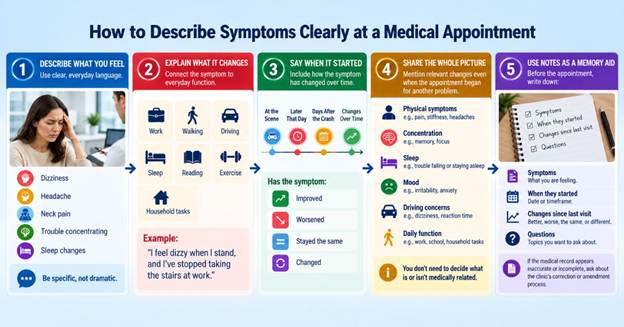
A useful medical conversation is specific rather than dramatic. You do not need to find the perfect medical term or make a symptom sound worse than it is. Describe what you are experiencing as accurately and completely as you can.
AHRQ encourages patients to tell clinicians about their physical and emotional symptoms, including details that may feel uncomfortable or unrelated. A few habits can make that conversation clearer:
- Describe the symptom and what it changes. “I feel dizzy when I stand up, and I have stopped taking the stairs at work” gives more context than either detail alone.
- Say when it started. Explain whether you noticed it at the scene, later that evening or several days afterwards.
- Bring up the whole picture. Sleep changes, trouble concentrating, low mood or unease about driving can be worth mentioning even during an appointment that began with neck or back pain.
- Use notes as a memory aid. A short list can help you remember symptoms, questions and changes since the previous appointment.
- Describe each visit honestly. Symptoms can improve, worsen or change. Consistency means being accurate about that progression, not repeating the same wording every time.
If something in your medical record is inaccurate or missing, ask the clinic about its correction process. Describe symptoms honestly so the record reflects what you are actually experiencing.
How to Get Copies of Your Medical Records[6]

Medical records are made up of different documents created at different stages of care. Knowing what to request can make the process clearer.
Start by asking the hospital, clinic or healthcare provider how to submit a records request. Rather than simply asking for ‘my file’, specify the records you need and the dates of care. Different departments may hold different parts of the record, so you may need to request some items separately.
AHRQ’s Release of Medical Information tool lists record types such as emergency department notes, discharge summaries, clinic notes, laboratory reports, radiology reports and consultation notes.
After a car accident, useful records may include:
- Emergency department and urgent-care notes
- Discharge summaries
- GP and follow-up visit notes
- Radiology reports
- Specialist or therapy notes
- Relevant laboratory or procedure reports
Imaging is worth asking about separately because the scan itself and the radiologist’s written report are different items.
The process and any fees depend on where you receive care. In the United States, HIPAA generally gives patients the right to inspect or obtain copies of health information held in a designated record set, subject to limited exceptions. Providers may charge certain reasonable, cost-based fees for copies. If you are elsewhere, ask your healthcare provider about the records-access process and any applicable charges.
If you notice something inaccurate or incomplete, ask the provider about its process for requesting an amendment.
Which Medical Records After a Car Accident Matter Most?
Different records answer different questions. This quick guide shows what each one can add to the overall picture of recovery.
No single document tells the whole story. The clearest picture usually comes from looking across the records and seeing how symptoms, function and care changed over time.
The record is only as complete as the conversation
A medical record reflects what was discussed, assessed and documented over time. Symptoms that appear later, including changes in sleep, concentration or daily activities, may only enter the record when they are raised with a healthcare professional.
The priority should always be care, not paperwork. Seek medical advice because of symptoms or concerns, not simply to create documentation.
This article provides general information only and is not medical advice. Speak with a qualified healthcare professional about symptoms after a car accident.

MindOwl Founder – My own struggles in life have led me to this path of understanding the human condition. I graduated with a bachelor’s degree in philosophy before completing a master’s degree in psychology at Regent’s University London. I then completed a postgraduate diploma in philosophical counselling before being trained in ACT (Acceptance and commitment therapy).
I’ve spent the last eight years studying the encounter of meditative practices with modern psychology.